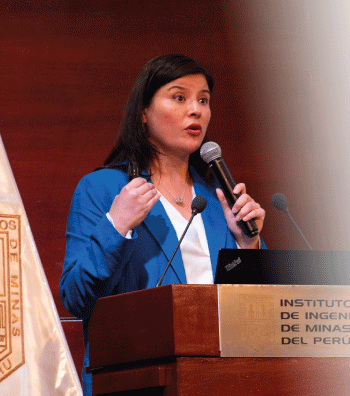
Graciela Arrieta: Gender Equity Must Move from Discourse to a Core Business Strategy in Mining
The Director of the Australia-Peru Chamber of Commerce and a member of the proEXPLO 2026 Organizing Committee analyzes the progress, challenges, and opportunities to close gender gaps in Peruvian mining.
Lima, January 16, 2026. Reducing gender gaps in Peruvian mining requires leadership, rigorous measurement, and the genuine integration of equity as a strategic pillar of the mining business, said Graciela Arrieta, Director of the Australia-Peru Chamber of Commerce and a member of the proEXPLO 2026 Organizing Committee.
The gender specialist in the mining and energy industry noted that, despite advances in the conversation around diversity, women’s participation in Peruvian mining remains close to 7%, a figure that underscores the need to transform the sector’s organizational culture.
A Gap Yet to Be Closed
“Policy matters, but leadership sets the pace. When an organization chooses to measure, manage through data, and focus on capabilities rather than limitations, equity ceases to be mere rhetoric and becomes a real driver of sustainability and competitiveness,” she stated.
Among the key measures to accelerate the closing of gender gaps, she highlighted the importance of committed leadership, effective measurement systems, and sector-specific policies adapted to the mining reality, such as inclusive camps, bias-free recruitment processes, work shifts compatible with personal life, and infrastructure suitable for all stages of the mining cycle.
Arrieta emphasized that technical and scientific education is a decisive factor in attracting and retaining female talent. The low participation of women in STEM careers remains one of the main structural barriers to their incorporation into mining, particularly in specialties such as geology, engineering, operations, metallurgy, and automation.
Inclusion
Finally, Arrieta noted that companies that incorporate women with strong technical expertise achieve more complementary teams, with improved analysis and risk management.
“When women gain access to adequate technical training, their participation strengthens in stages such as exploration, where they already represent around 10% of employment, the highest share across the mining cycle. This demonstrates that education is the true gateway to an industry that is increasingly sophisticated and multidisciplinary,” she concluded.