proEXPLO 2026: “Mineral Exploration in South America Is Growing at a Moderate but Steady Pace”
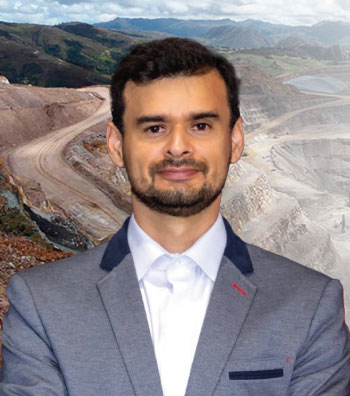
Fernando Rivera, a member of the proEXPLO 2026 Technical Committee, notes that regulatory certainty and technology are key to accelerating new discoveries in the region.
Lima, February 10, 2026.- Mineral exploration in South America continues to show moderate but sustained growth, said Fernando Rivera, geologist and member of the proEXPLO 2026 Organizing Committee. He warned that consolidating this trend will require greater regulatory and social certainty, clear rules, and predictable processes, as well as the use of new tools and improved access to high-quality geological information.
Exploring Better and Deeper
Drawing on his experience at Antofagasta Minerals, Rivera indicated that one of the most relevant trends in mineral exploration is the search for deeper targets with higher technical risk, supported by new tools and integrated approaches.
“Projects such as Filo del Sol, Alpala, Cachorro, and Encierro, featured at the Core Shack, exemplify the high mineral potential associated with this type of exploration in South America,” the geological engineer said in an interview with the Peruvian Institute of Mining Engineers.
He also noted that mineral exploration in South America is experiencing moderate but sustained growth. In 2023, exploration spending in the region increased by 12%, and nearly half of the global copper exploration budget was invested in South America. In addition, projections indicate annual growth of between 5% and 6% in exploration investment through 2033.
“It is necessary to move toward greater regulatory and social certainty, clear rules, and predictable processes, as well as the use of new tools to explore deeper targets and improved access to high-quality geological information that accelerates decision-making,” he stated.
A Key Space
Rivera further explained that the vision behind the Core Shack has been to create a high-level technical discussion environment, where drill core becomes the central element for comparing geological models, validating targeting criteria, and analyzing exploration risks and opportunities.
“We seek to promote in-depth technical discussions, based on real geological evidence, that connect different players across the industry,” the geologist emphasized.
For the 2026 edition, the Core Shack already has 16 confirmed projects out of a total of 20 available spaces, selected under clear technical criteria.
“Prioritization has focused on showcasing recent and relevant regional discoveries at advanced exploration stages, as well as high-quality early-stage projects in Peru, allowing us to present both consolidated results and new exploration opportunities,” he explained.
The participation of projects from Argentina, Chile, Ecuador, Nicaragua, and Peru provides a comparative regional perspective, integrating diverse geological settings and mineralization styles. This diversity is reflected in an exhibition that represents different metallogenetic environments, enriching technical analysis and broadening attendees’ understanding of the region’s exploration potential.
With this proposal, the proEXPLO 2026 Core Shack reaffirms its role as an essential technical space for fostering knowledge, debate, and future discoveries that will shape the course of mineral exploration in the region.